Walk through any Chicago medical practice after hours and you'll see the problem hiding in plain sight: charts left at workstations, monitors still logged in, appointment schedules taped to the wall, and paperwork stacked at check-in. A cleaning crew moves through all of it. If that crew hasn't been trained on how to behave around protected health information (PHI), your practice has a compliance gap that has nothing to do with your clinical care and everything to do with who you let in the door at night.
HIPAA — the Health Insurance Portability and Accountability Act — governs how PHI is handled, stored, and disclosed. Most practice owners think of it in terms of their EHR, their front desk, and their staff. Fewer think about the vendors who physically occupy the space when no clinicians are present. Yet a janitorial vendor is exactly the kind of third party that can create an inadvertent disclosure — or, handled correctly, quietly protect your practice every single night.
This guide explains what HIPAA compliance really means for a cleaning company, what to ask before you hire one, and how a HIPAA-aware cleaning program actually works in a real Chicago medical office.
Here's the nuance that trips up a lot of practice owners. A cleaning company is usually not a "covered entity" and, in most arrangements, not a "business associate" either — because it isn't hired to create, receive, maintain, or transmit PHI on your behalf. It's hired to clean. But that legal distinction does not mean the risk disappears. A crew that reads, photographs, moves, or throws away a document with patient information can still cause a reportable incident, and the practice — the covered entity — is the one left explaining it.
So the honest answer to "does my cleaning company need to be HIPAA compliant?" is this: cleaning companies are not "HIPAA certified," and no such certification exists. What they must be is HIPAA-aware — trained to work around PHI without ever accessing or disturbing it, staffed by accountable people, and willing to sign confidentiality terms. If your practice's arrangement does rise to the level of a business associate relationship, a Business Associate Agreement (BAA) may be appropriate, and a professional vendor will have that conversation with you rather than dodge it.
The practical takeaway for any Chicago practice: don't ask a vendor to prove a certification that doesn't exist. Ask them to prove training, accountability, and process. That's what actually reduces your risk.
Before you let any vendor into your suite, put these questions on the table. The answers separate a HIPAA-aware medical cleaner from a general janitorial outfit that happens to be available.
You want a clear yes, with specifics: crews are trained not to read, move, photograph, or discard patient documents, and to clean around active PHI rather than relocating it. Generic "we're professionals" answers aren't enough.
Directly employed, W-2 crews are accountable in a way that rotating gig labor is not. Background checks matter when the workforce has unsupervised access to a space full of sensitive information.
Consistent team assignments mean fewer people ever set foot in your practice, and the crew that returns already knows your layout, your compliance requirements, and your no-touch zones.
A competent medical cleaner knows the line between routine environmental cleaning (theirs) and regulated medical-waste disposal (your licensed hauler's). They service the areas around sharps containers safely and never empty or handle the containers themselves.
COIs protect both parties and are standard for any vendor working in a medical building. If a vendor hesitates, that's your answer.
Willingness to put confidentiality in writing is a baseline signal of a serious healthcare vendor.
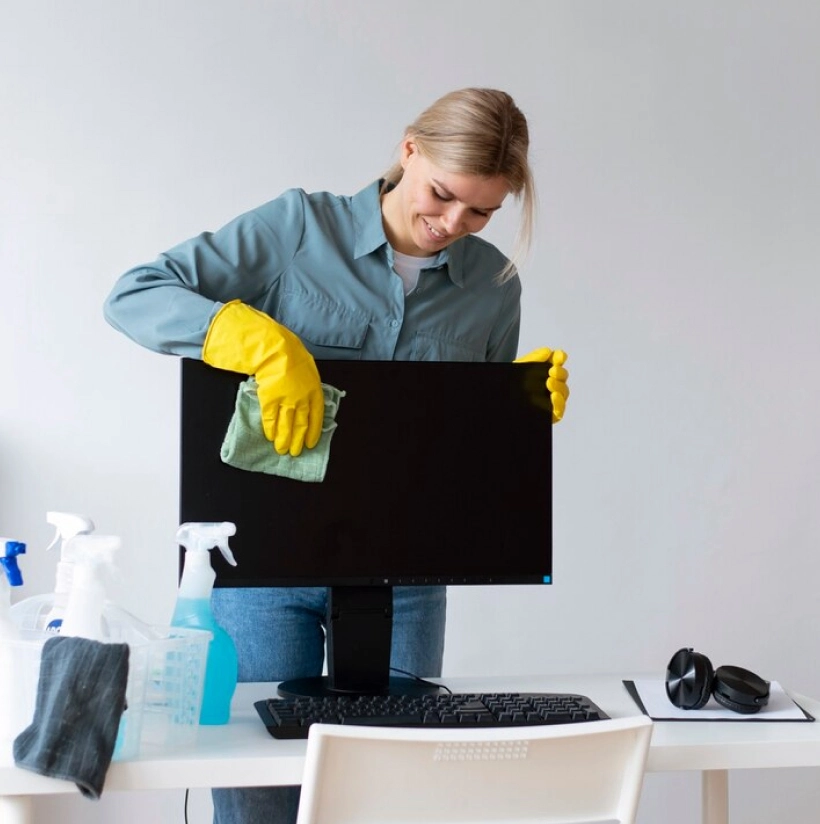
Training on paper means nothing if it doesn't change how the crew works. In a HIPAA-aware program, the crew arrives after patient hours and works to a healthcare-specific checklist rather than a generic office routine. When they reach a workstation with a chart or a logged-in monitor, they don't tidy it, stack it, or move it — they clean the surfaces around it and leave the PHI exactly where they found it. Trash from clinical areas is handled per your protocol; anything that looks like it contains patient information is never treated as ordinary recycling.
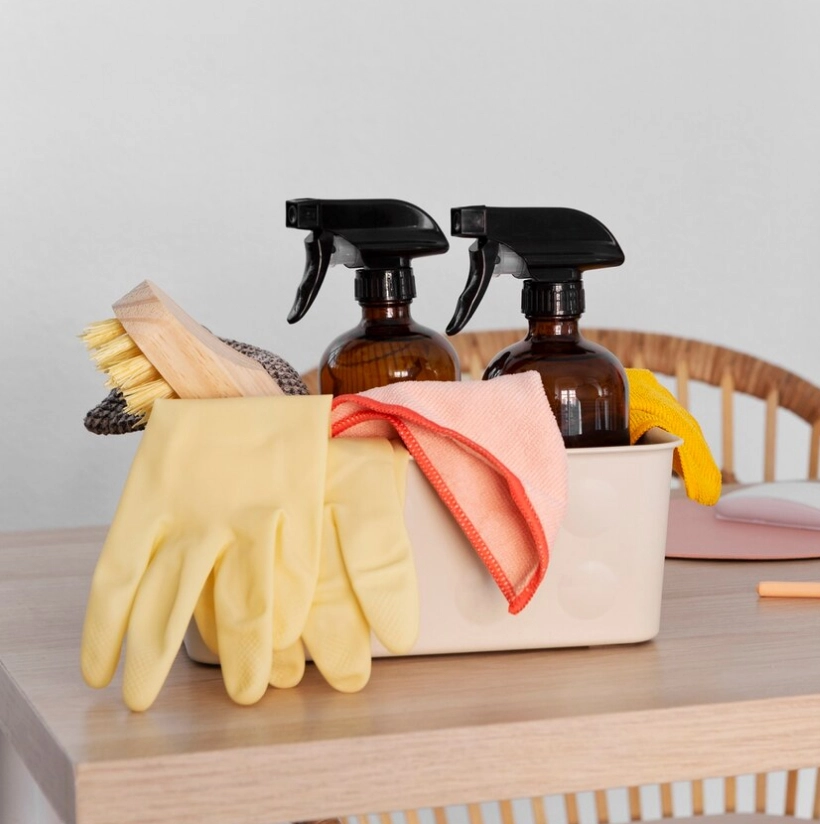
Color-coded microfiber keeps exam-room cloths separate from restroom cloths so nothing cross-contaminates between a treatment surface and a toilet. EPA-registered hospital disinfectants are applied with the correct dwell time — the number of minutes a surface must stay wet to actually kill pathogens — instead of being sprayed and immediately wiped, which does almost nothing. High-touch points get disinfected every visit: door handles, light switches, chair arms, counters, cabinet pulls, and shared equipment.
None of this is exotic. It's disciplined, repeatable, and documented — which is exactly what a medical practice needs from the vendor that occupies its space every night. You can see the full scope of how we approach this on our medical and healthcare office cleaning service page.
Chicago's medical real estate ranges from single-provider dental suites in neighborhood storefronts to multi-tenant medical office buildings in the Loop and the suburbs. In a shared medical building, your cleaning vendor may move between several practices in one night, which raises the stakes on cross-contamination and confidentiality alike. Property managers of these buildings increasingly require proof of insurance and vetted crews before a vendor is approved — and for good reason.
There's also a patient-trust dimension that doesn't show up in any regulation. Patients notice a clean, orderly practice, and they notice the opposite even faster. A visibly disinfected exam room and a spotless restroom quietly reinforce that your practice takes their safety seriously. When cleaning is inconsistent — a missed restroom here, dust on the vents there — it undercuts the clinical confidence you've worked to build. For general office areas outside clinical space, many practices pair medical cleaning with standard commercial janitorial services under one reliable vendor.
Just as important as knowing what to look for is knowing what to walk away from. Some warning signs surface in the first conversation, before a crew ever sets foot in your Chicago practice. A vendor who can't clearly explain the difference between environmental cleaning and regulated medical-waste disposal is telling you they've never thought about the boundary that matters most in a clinical space. A vendor who promises to "handle everything, including the sharps" is worse — that's not confidence, it's a compliance liability, because sharps and regulated waste belong exclusively to your licensed hauler.
Other red flags are quieter. A company that staffs with rotating subcontractors or day-labor can't guarantee the same background-checked people return each night, which is the opposite of what a space full of PHI needs. A vendor who balks at providing a Certificate of Insurance, or who treats a confidentiality clause as an unusual request, hasn't worked in healthcare before. And a crew that sprays disinfectant and wipes it off in the same motion doesn't understand dwell time — meaning the "disinfection" is cosmetic. None of these are hard to spot once you know to look, and any one of them is reason enough to keep interviewing.
The pattern behind all of them is the same: a general janitorial mindset applied to a clinical environment. Office cleaning optimizes for appearance and speed. Medical cleaning optimizes for infection control, confidentiality, and documentation — and the vendors who don't grasp that distinction reveal it quickly if you ask the right questions.
A vendor can say all the right things in a sales meeting and still leave your practice exposed if none of it is in writing. The strongest protection is to make confidentiality and scope contractual. A clear service agreement should name the areas cleaned, the frequency, the surfaces disinfected on every visit, and — critically — the boundary between the crew's environmental cleaning and your clinical and medical-waste responsibilities. When that boundary lives in the contract, there's no ambiguity later about who was responsible for what.
Confidentiality terms belong in writing too. Even when a cleaning company isn't a formal business associate, a signed confidentiality clause commits the crew to not accessing, moving, photographing, or discarding anything that could contain patient information, and gives your practice recourse if that commitment is broken. If your particular arrangement does rise to a business associate relationship, a Business Associate Agreement formalizes the same expectations under HIPAA. A serious healthcare vendor treats both as routine paperwork, not an obstacle.
Documentation is the third leg. Ask that the vendor keep a simple record of what was cleaned and when — a cleaning log you can produce during an accreditation review, a health-department visit, or a conversation with a nervous patient. For a Chicago practice, that paper trail turns "we clean regularly" into "here is exactly how, how often, and by whom," which is a far stronger position when someone asks.
Allora Cleaning, led by owner Kenita Jones Taylor, provides HIPAA-aware medical and dental office cleaning across Chicago and the surrounding suburbs. Our crews are trained, background-checked, and directly accountable, and we keep team assignments consistent so the same trusted people return to your practice. We follow healthcare-specific checklists, use hospital-grade disinfectants with proper dwell times, and clean around active PHI without ever disturbing it.
We're fully licensed and insured, and Certificates of Insurance are available on request for your building or practice. We coordinate our scope with your compliance requirements — including the clear boundary between our environmental cleaning and your licensed medical-waste disposal — so responsibilities are documented and nothing falls through the cracks. Whether you run a dental office that needs after-hours operatory turnovers or a busy multi-provider clinic that can't pause patient care, we build the schedule around you.
Ready to close the compliance gap hiding in your cleaning contract? Book a consultation or request a free estimate, and we'll walk your Chicago practice, map the no-touch zones, and build a HIPAA-aware plan that fits your rooms and your schedule.
Cleaning companies aren't "HIPAA certified" — that certification doesn't exist. What they must be is HIPAA-aware: crews trained not to access, move, or discard patient records, staffed by accountable, background-checked people, and willing to sign confidentiality terms or a Business Associate Agreement if the arrangement requires one. Allora Cleaning trains its Chicago crews on HIPAA-aware conduct and cleans around active PHI without disturbing it.
Often not — a cleaning company usually isn't a business associate because it isn't hired to handle PHI on your behalf. But if your specific arrangement does involve access to PHI, a BAA may be appropriate. A professional medical cleaner will discuss this openly rather than avoid it.
Routine environmental cleaning stays with the cleaning crew; regulated medical-waste and sharps disposal stays with your licensed medical-waste hauler. A competent vendor services the areas around sharps containers safely and never empties or handles the containers themselves.
Yes. Most Chicago medical and dental practices are cleaned after close, before open, or on weekends so exam rooms, operatories, and waiting areas are turned over without interrupting patient care. Frequency is built around your patient volume and room count.
Confirm the vendor carries general liability coverage and that the COI can be issued to your practice or building as required. Certificates of Insurance are standard for medical-building vendors, and a professional cleaner provides them on request.
No — and a HIPAA-aware vendor never should. Cleaning crews have no reason to touch charts, screens, or files, and a professional medical cleaner trains staff to clean around active PHI without reading, moving, or discarding it. If a vendor's crews are handling your paperwork for any reason, that's a process failure worth correcting immediately.