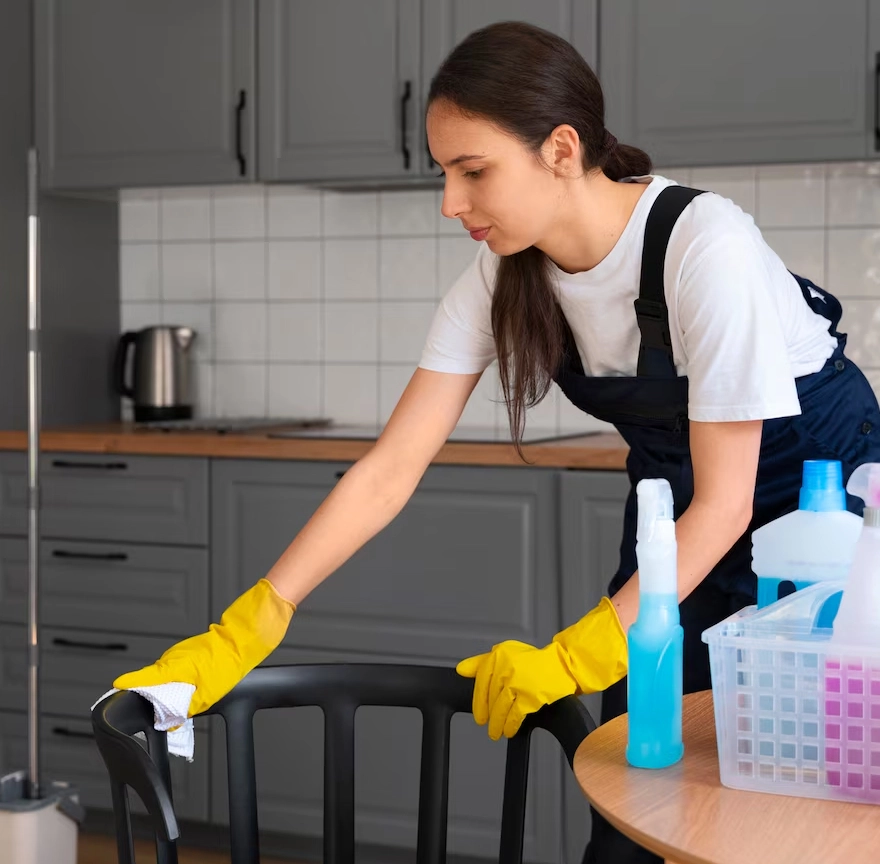
The single biggest mistake Chicago medical practices make when hiring a cleaning provider is treating medical office cleaning like office cleaning with a few extra disinfectants. It is not. Clinical environments carry regulatory exposure, infection control standards, and patient-privacy requirements that standard commercial crews are neither trained for nor insured to handle.
This guide walks Chicago medical office managers, dental practices, urgent care operators, and clinic administrators through what a qualified janitorial provider should actually deliver — what healthcare cleaning standards look like in practice, why HIPAA awareness matters for the cleaning crew, the infection control fundamentals every medical cleaner should follow, and how to vet a Chicago janitorial partner who can meet all of it.

Medical facilities in Chicago fall under several overlapping standards depending on the practice type. Ambulatory care centers, dental offices, primary care clinics, urgent care, physical therapy, dermatology, and surgical centers all have their own baselines. Common across them:
All disinfectants used in patient care areas must be EPA-registered and appropriate to the pathogen risk. For most Chicago medical offices, this means EPA List N-registered products for bloodborne pathogen cleanup, hospital-grade quaternary ammonium disinfectants for exam room surfaces, and dedicated restroom disinfectants rotated to avoid resistance.
Every disinfectant has a required contact time (dwell time) printed on the label — typically 1–10 minutes. Cleaning staff who spray-and-immediately-wipe are not disinfecting; they are just moving contamination around. Qualified medical cleaning crews are trained to respect dwell times and use products in the order their dwell times allow.
Medical offices in Chicago should use color-coded microfiber cloths and mops — typically red for restrooms, yellow for patient rooms, blue for common areas, green for break rooms. This prevents cross-contamination between zones. If your current provider uses the same rag throughout the building, that is a red flag.
Exam rooms, procedure rooms, and any area where patient contact occurs follow stricter protocols than waiting rooms, administrative offices, and break rooms. Patient-contact zones require terminal cleaning after procedures, enhanced disinfection between patients for shared equipment, and special handling of any contaminated surface.
Chicago medical offices subject to Joint Commission, CMS, or state health department inspection need documented cleaning logs — what was cleaned, when, by whom, with what product. Digital QA logs are now standard and typically preferred because they are easier to produce during inspections.
HIPAA is not just a records-handling rule. Cleaning crews inside a Chicago medical office are considered "workforce members" under HIPAA and must be trained to respect Protected Health Information (PHI). The practical implications:
Every cleaner entering your Chicago medical practice should have documented HIPAA training on file with the cleaning company. This training covers what PHI looks like, what to do if PHI is visible on desks or monitors, and what to do if PHI is discovered in trash or recycling.
Medical cleaning crews should never read patient files, never photograph any documents or screens, and never remove any paper from the facility except through secured shredding protocols. Crews trained by our team at Allora Cleaning Chicago are explicitly briefed on these rules and sign acknowledgments before their first shift at a medical client.
Workforce members — including cleaning crews — should encounter locked screens and cleared-desk policies during after-hours cleaning. If your practice currently leaves monitors unlocked overnight or leaves patient charts visible, that is a HIPAA gap that predates the cleaning company. Good cleaning partners will flag these gaps but not bypass them.
Some Chicago medical practices require cleaning vendors to sign a Business Associate Agreement (BAA) or a confidentiality addendum. This is reasonable and easy to provide — any qualified medical cleaning provider in Chicago will have a template ready. Providers who refuse BAAs or similar confidentiality documents should not be cleaning medical facilities.
All paper disposal from Chicago medical offices should route through locked shred bins, not regular trash. Cleaning crews handle the locked bins (empty liners, secure bins) but do not access contents. Regular trash pickup from Chicago medical offices should be limited to non-PHI waste, and crews should be trained to identify and segregate suspicious paper.
Clinics rely on our janitorial cleaning across Naperville and beyond — also see our medical and dental office guide.


Beyond HIPAA, Chicago medical cleaning crews need working knowledge of infection control practices. This is not the level of a nurse or infection preventionist, but it is well above what a residential or standard commercial cleaner knows.
Every medical cleaning crew member should have Bloodborne Pathogen training (OSHA 29 CFR 1910.1030) and documented hepatitis B vaccination or declination on file. Crews should carry spill kits, know how to respond to a blood or bodily fluid spill, and understand PPE requirements. This is foundational and non-negotiable for any Chicago medical cleaning vendor.
The correct cleaning order in a medical exam room is top-to-bottom, clean-to-dirty, and wiping should be in a single direction — never back-and-forth, which redistributes contaminants. Sinks and restrooms are cleaned last, never first. Crews who do not know this are not medical-grade.
Mops, buckets, microfiber cloths, and vacuums used in patient-care areas should be dedicated to those zones — not shared with break rooms, administrative offices, or lobbies. This is where color-coding systems earn their keep.
Medical cleaning crews should know the high-touch surface list for each room type: exam tables, blood pressure cuffs, stethoscope hooks, cabinet pulls, light switches, door handles, keyboards, phone handsets, thermometer holders, and countertops. These surfaces get disinfected every visit, not just wiped on deep-clean day.
Any Chicago medical facility performing procedures (urgent care, surgical, dermatology, dental) needs terminal cleaning protocols for procedure rooms between patients or at end of day. This is more rigorous than routine cleaning and requires specific dwell-time disinfectants. Crews without this training cannot safely service procedure rooms.
Chicago medical offices that try to save money with generic office cleaners routinely run into problems: missed disinfection steps that cause infection control deficiencies during inspection, cross-contamination between zones, incorrect product use that damages exam equipment, improper handling of biohazard waste, and HIPAA exposure when untrained crews encounter PHI.
A specialized Chicago medical cleaning team — one that services only healthcare and regulated facilities — brings standing protocols, documented training, and the right equipment by default. The incremental cost over generic commercial cleaning is usually 15–25%, which is trivial compared to the cost of a single inspection deficiency or HIPAA breach.
Allora Cleaning Chicago operates a dedicated medical services division inside our broader janitorial cleaning program. Every crew member working in a Chicago medical office has documented HIPAA and Bloodborne Pathogen training, works from written protocols for each room type, and uses color-coded equipment systems. We carry the insurance and liability coverage Chicago medical practices require, and we provide Business Associate Agreements on request.
Different healthcare practice types have different baseline cleaning frequencies. General guidance for Chicago medical offices:
For a deeper breakdown of cleaning frequency by facility type, see our guide to commercial cleaning schedules for Chicago buildings. Frequency should always scale with patient volume and procedure complexity.
Allora Cleaning Chicago staffs dedicated medical cleaning crews across the Chicagoland healthcare market. Medical cleaning routes are built separately from general commercial routes so crew training and equipment stay specialized.
If your Chicago medical office sits in any of these corridors — or anywhere else in Chicagoland — we can route a specialized medical cleaning crew with full HIPAA and Bloodborne Pathogen training.
When interviewing Chicago janitorial providers for your medical office, work through this checklist:
A qualified Chicago medical cleaning provider will have answers ready for every one of these questions. If the conversation stalls on half of them, the provider is not medical-grade regardless of what their marketing says.
If your Chicago medical office needs a specialized janitorial partner — whether you are opening a new clinic, replacing an underperforming vendor, or scaling an existing practice — the first step is a free walkthrough. We visit your facility, review your current scope and protocols, identify any inspection-readiness gaps, and provide a written scope and pricing proposal within two business days. We service medical offices across downtown Chicago, the Loop, Naperville, Schaumburg, Orland Park, and the surrounding Chicagoland area.
Book a Chicago medical cleaning walkthrough or reach our team through our contact page — we respond to every healthcare inquiry within one business day.
Yes. Cleaning crews inside a medical facility are HIPAA workforce members whenever PHI is reasonably accessible during their work. Every crew member should have documented HIPAA training, and the cleaning vendor should be willing to sign a Business Associate Agreement or confidentiality addendum on request.
Yes, typically 15–25% more depending on scope. The premium reflects specialized training, documented protocols, color-coded equipment systems, EPA-registered product use, and the liability insurance coverage required for healthcare work. It is a trivial cost next to the potential cost of an inspection deficiency or infection control lapse.
Terminal cleaning is a more thorough end-of-day or between-procedure clean of a room, including enhanced disinfection of all surfaces and equipment. Chicago clinics performing procedures (urgent care, dermatology, surgical, dental) typically need terminal cleaning for procedure rooms. General primary care offices usually need standard nightly cleaning with enhanced exam room protocols.
Exam rooms should be cleaned nightly at minimum with enhanced disinfection between patients for shared equipment. High-volume Chicago practices often add day porter support for intra-day cleaning — restroom checks, waiting room turnover, and high-touch surface disinfection every 2–3 hours during patient hours.
Yes, if the vendor is qualified for both environments. The clinic scope follows medical protocols and the administrative office follows standard commercial protocols. Our team at Allora Cleaning Chicago handles this exact split for several multi-site Chicago healthcare clients, with dedicated medical-trained crews on the clinical side and standard commercial crews on the administrative side.
Yes. Our Chicago dental cleaning protocols include operatory disinfection, sterilization-area support (we do not handle instrument sterilization, which must be done by clinical staff), waiting room and restroom nightly service, and X-ray room handling. Dental offices in Chicago typically contract us for 5-night or 6-night cadence with periodic deep cleans.

Written by the Allora Cleaning Chicago janitorial operations team based on active healthcare accounts across Chicagoland.